KPV Stack 80mg
Product Overview
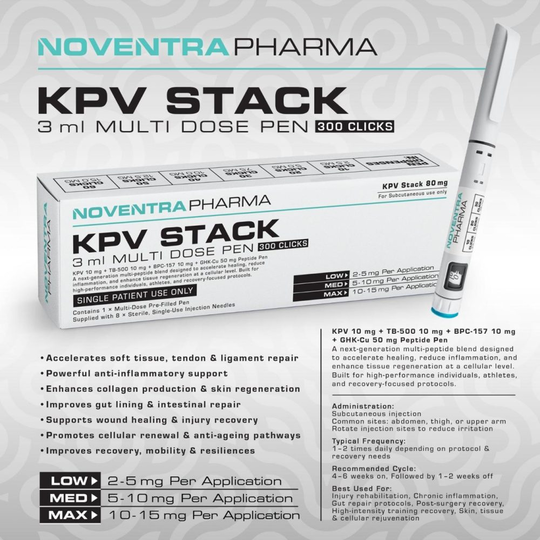
KPV is three amino acids: lysine, proline and valine. It is the C-terminal fragment of alpha-melanocyte stimulating hormone, and it carries the anti-inflammatory activity of the parent hormone without the pigmentation or melanocortin receptor activity that comes with the full molecule. Supplied here as an 80mg stack.
Product Specifications
- Active ingredient: KPV (Lys-Pro-Val)
- Total amount: 80mg per vial
- Format: Lyophilised powder, sealed vial
- Reconstitution: Bacteriostatic water included in the box
- Regulatory status: Research use only. Not a registered medicine in South Africa and not evaluated by SAHPRA.
What KPV Is
Alpha-MSH is a potent anti-inflammatory peptide, but it also drives pigmentation and appetite signalling through the melanocortin receptors. Researchers looking to separate those effects found that the last three residues retained much of the anti-inflammatory activity on their own. KPV is that fragment.
Because it does not act on the melanocortin receptors, it is studied in a different context to Melanotan II or PT-141 despite sharing an origin. The literature is mostly inflammation and mucosal biology, not cosmetics.
Research Applications
Inflammatory Signalling
Studied for suppression of pro-inflammatory cytokine production in immune cell models.
NF-kB Pathway
Investigated for interference with NF-kB activation, a central inflammatory transcription factor.
Gut and Mucosal Models
Examined in colitis and intestinal inflammation models, including work on epithelial uptake transporters.
Skin Research
Researched in dermatological inflammation and wound models, often alongside copper peptides.
Antimicrobial Activity
Alpha-MSH derived peptides have documented antimicrobial activity against bacteria and fungi, and KPV retains part of it.
Mechanism of Action
Mechanisms under investigation:
- Inhibition of NF-kB nuclear translocation
- Reduced TNF-alpha, IL-1 beta and IL-6 production
- Uptake through PepT1 in intestinal epithelium
- Antimicrobial activity independent of melanocortin receptors
- No MC1R activity, and therefore no pigmentation effect
- Small size and short sequence, which affects stability
Commonly Researched Alongside
- BPC-157
- TB-500
- GHK-Cu
Listed because these pairings come up constantly in published protocols and in what people actually order together, not because we are recommending a combination.
Reconstitution and Handling
Supplied lyophilised, with bacteriostatic water in the box. Reconstitution is done by the buyer, and the volume you choose determines the concentration you end up with. There is no single correct volume, only the one that makes your intended measurement easy to read on the syringe you are using.
- Let the vial reach room temperature before you open it.
- Wipe the stopper with an alcohol swab and let it dry.
- Run the bacteriostatic water slowly down the inside wall of the vial rather than straight onto the powder.
- Swirl gently until clear. Do not shake.
- Label the vial with the date and the concentration. You will not remember it in three weeks.
Our peptide calculator will work out the concentration and the volume per measurement for you once you have chosen a reconstitution volume. Our reconstitution guide walks through the whole process step by step.
Storage
- Ships lyophilised and is stable at room temperature in transit.
- Refrigerate on arrival and keep out of direct light.
- Do not freeze a reconstituted vial.
- Once reconstituted, keep refrigerated and treat it as a short shelf life rather than an indefinite one.
- Discard if the solution turns cloudy, changes colour or shows visible particles.
- Keep out of reach of children.
Storage, reconstitution and handling after delivery are the buyer’s responsibility.
What This Page Does Not Claim
Most KPV work is cell culture and animal models, with a strong bias toward gut inflammation. Human trial data is limited. The tripeptide is also short and unprotected, so handling and storage matter more here than with a larger, more stable peptide.
Regulatory Status and Notice
KPV is not a registered medicine in South Africa and has not been evaluated by SAHPRA. It is supplied as a lyophilised vial for laboratory research use only, and is not for human or veterinary consumption.
Nothing on this page is medical advice, and none of the research described below establishes a clinical outcome in people. Where the evidence is thin, we say so on the page rather than leaving you to find out afterwards.