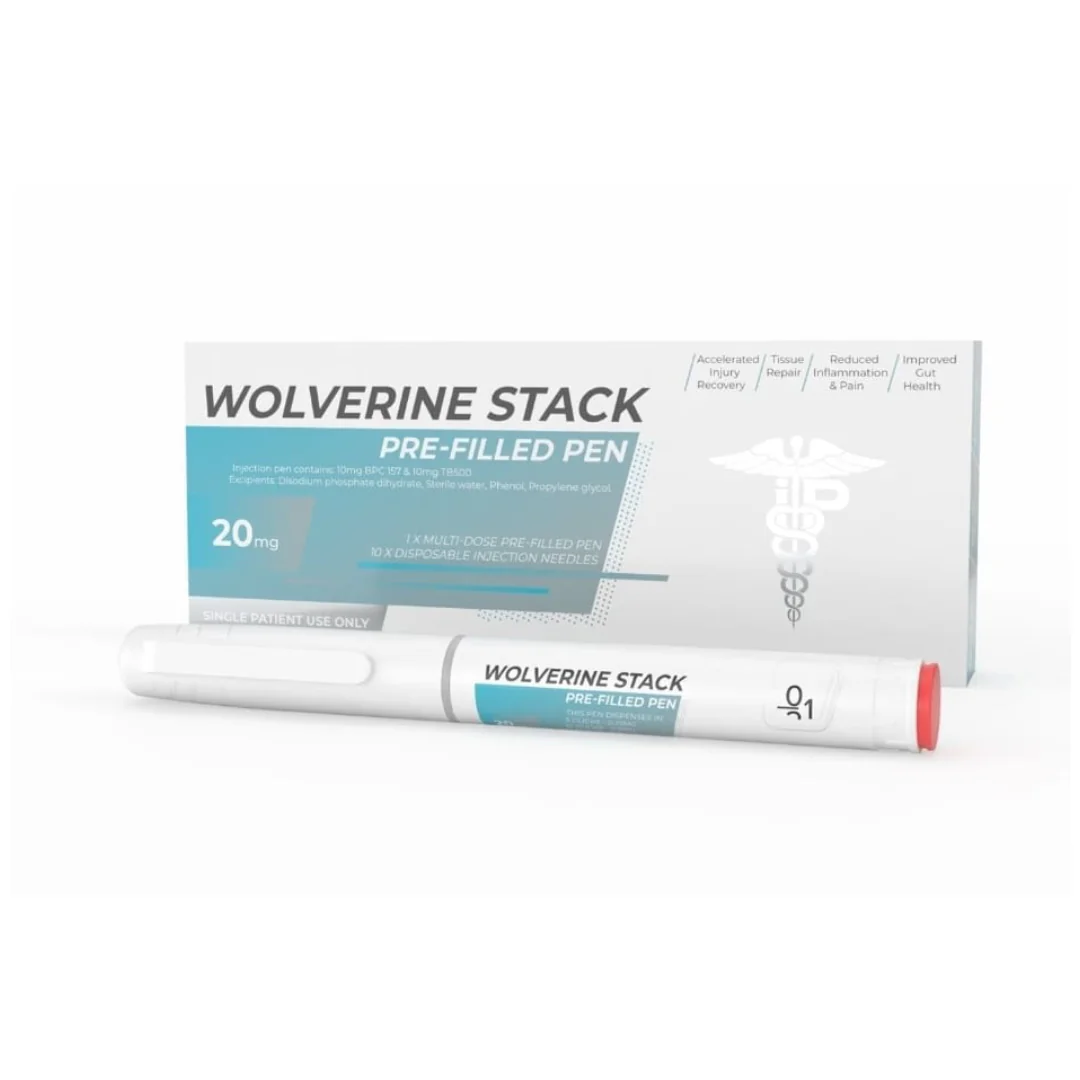
Wolverine Stack 20mg
Product Overview
The same TB-500 and BPC-157 pairing as our 10mg stack, supplied at 20mg in a single vial. Twice the material at less than twice the price, which is the only real reason to choose this one over the smaller vial.
Product Specifications
- Active ingredients: TB-500 (thymosin beta-4 fragment) and BPC-157
- Total amount: 20mg combined per vial
- Format: Lyophilised powder, sealed vial
- Reconstitution: Buyer supplied bacteriostatic water
- Ratio: Confirm the exact split with us before ordering if your protocol depends on it
- Regulatory status: Research use only. Not a registered medicine in South Africa and not evaluated by SAHPRA.
Why These Two Together
BPC-157 is a fifteen amino acid sequence derived from a protein found in gastric juice. Its research literature centres on angiogenesis, growth factor receptor expression and the nitric oxide system. TB-500 is a synthetic fragment of thymosin beta-4, a protein whose documented role is binding actin, the structural protein cells rely on to move and rebuild.
One is a signalling story, the other a structural one. That difference is the argument for running them together, and it is why the combination dominates published repair protocols.
A word on the vial size. At 20mg in one vial you are committing to a single reconstitution and a single opened stopper. If your protocol runs long enough to use it, that is an advantage. If it does not, the 10mg vial wastes less.
Research Applications
Soft Tissue Models
Studied in tendon, ligament and muscle injury models across both compounds.
Angiogenesis
BPC-157 research focuses on new blood vessel formation and VEGF receptor expression.
Cell Migration
TB-500 research centres on actin sequestration and the cell migration that depends on it.
Gastrointestinal Research
BPC-157 originates in gut biology and much of its literature remains there.
Inflammatory Response
Both are examined for effects on inflammatory signalling during remodelling.
Mechanism of Action
Across the two compounds, the researched mechanisms include:
- Actin binding and sequestration, driving cell migration
- VEGF receptor 2 expression and angiogenic signalling
- Nitric oxide system interaction
- Fibroblast recruitment and collagen organisation
- Growth factor receptor upregulation in injured tissue
- Modulation of inflammatory mediators during repair
Commonly Researched Alongside
- GHK-Cu
- KPV
Listed because these pairings come up constantly in published protocols and in what people actually order together, not because we are recommending a combination.
Reconstitution and Handling
Supplied lyophilised. Reconstitution is done by the buyer with bacteriostatic water, and the volume you choose determines the concentration you end up with. There is no single correct volume, only the one that makes your intended measurement easy to read on the syringe you are using.
- Let the vial reach room temperature before you open it.
- Wipe the stopper with an alcohol swab and let it dry.
- Run the bacteriostatic water slowly down the inside wall of the vial rather than straight onto the powder.
- Swirl gently until clear. Do not shake.
- Label the vial with the date and the concentration. You will not remember it in three weeks.
Our peptide calculator will work out the concentration and the volume per measurement for you once you have chosen a reconstitution volume.
Storage
- Ships lyophilised and is stable at room temperature in transit.
- Refrigerate on arrival and keep out of direct light.
- Do not freeze a reconstituted vial.
- Once reconstituted, keep refrigerated and treat it as a short shelf life rather than an indefinite one.
- Discard if the solution turns cloudy, changes colour or shows visible particles.
- Keep out of reach of children.
Storage, reconstitution and handling after delivery are the buyer’s responsibility.
What This Page Does Not Claim
Neither compound has meaningful human trial data. Both are marketed on the strength of rodent injury models, and a healed rat tendon is not a statement about your shoulder. BPC-157 is on the WADA prohibited list, which matters if you compete.
Regulatory Status and Notice
The Wolverine Stack is not a registered medicine in South Africa and has not been evaluated by SAHPRA. It is supplied as a lyophilised vial for laboratory research use only, and is not for human or veterinary consumption.
Nothing on this page is medical advice, and none of the research described below establishes a clinical outcome in people. Where the evidence is thin, we say so on the page rather than leaving you to find out afterwards.
Further reading: BPC-157 vs TB-500, and how they differ.