Semax and Selank come from the same laboratory, were built using the same trick, and are usually mentioned in the same breath. Their reputations point in opposite directions. Semax is the one people associate with focus. Selank is the one people associate with calm.
The short version
- Semax is built from a fragment of ACTH, a pituitary hormone. It is studied mainly for attention, memory and neurotrophic signalling.
- Selank is built from tuftsin, a small immune-signalling fragment. It is studied mainly for anxiety and stress response.
- Both were developed in Russia, both are registered medicines there, and neither is approved anywhere else.
Where they come from
Both were developed at the Institute of Molecular Genetics of the Russian Academy of Sciences. Both start from a short, naturally occurring peptide fragment that breaks down within minutes in the body, and both solve that the same way: by adding three amino acids, proline, glycine and proline, to the end. That tail slows breakdown enough for the fragment to be studied properly.
So the design is shared. What the fragment does is not.
Semax
Semax starts from a fragment of adrenocorticotropic hormone, stripped of the part that drives the stress-hormone response. What is left has been studied for effects on attention, learning, memory and mental fatigue, and in Russia for recovery after stroke.
The mechanism most often discussed is brain-derived neurotrophic factor, BDNF, a protein involved in how neurons grow, survive and form connections. Research has also looked at effects on dopamine and serotonin signalling.
Selank
Selank starts from tuftsin, a four amino acid fragment of an antibody that plays a part in immune signalling. With the proline, glycine and proline tail added, the research moved away from immunity and towards anxiety.
It has been studied for reducing anxiety-related behaviour without the drowsiness associated with classical anti-anxiety medicines. The mechanisms discussed include effects on GABA signalling, on serotonin, and on the enzymes that break down enkephalins, the body’s own calming peptides.
Side by side
- Starting point: Semax, a fragment of ACTH. Selank, tuftsin.
- Main research area: Semax, focus, memory and neuroprotection. Selank, anxiety and stress.
- Mechanisms discussed: Semax, BDNF and dopamine. Selank, GABA, serotonin and enkephalins.
- Status: both registered in Russia, neither approved in South Africa or elsewhere.
They are often researched together because the goals complement each other: one aimed at sharper, one at steadier. That is also why you will see blends of the two sold as a single product.
The versions with longer names
You will also come across N-acetyl Semax amidate and N-acetyl Selank amidate. These are the same peptides with both ends chemically capped, which is intended to make them more stable. There is less published research on the capped versions than on the originals. We stock the standard forms.
A caveat on the evidence
Most of the published work on both is Russian, much of it small, and not all of it is available in English. That does not make it wrong. It does mean neither compound has been through the kind of large, independently replicated trials that a Western medicines regulator would ask for, and it is worth reading claims about them with that in mind.
What we stock
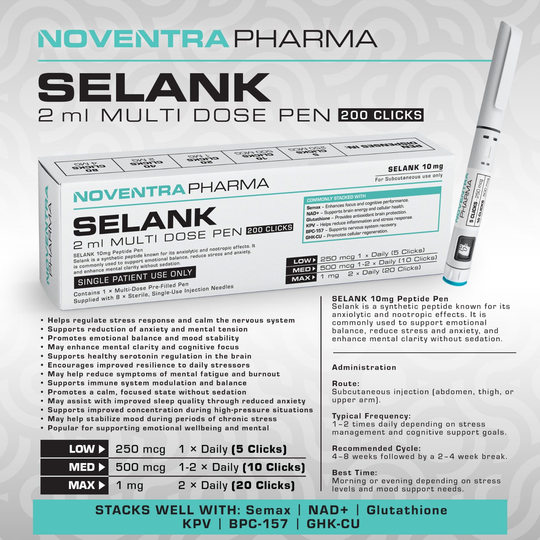
Semax 20mg, as a pre-filled pen, and Selank 10mg, as a self-mix vial with bacteriostatic water included. Both are supplied for laboratory research use only and are not for human consumption.
Both sit in our cognitive and mood range. For the vial, see how to reconstitute a peptide vial.