GHK-Cu is searched for more than almost any other compound in the skin and beauty category, and it is one of the few with a research history going back fifty years. It is also one of the easiest to oversell. This is what it is, what the evidence covers, and where the evidence stops.
What GHK-Cu is
GHK is a peptide three amino acids long: glycine, histidine and lysine. The Cu is a copper ion bound to it. It occurs naturally in human plasma, and plasma levels fall with age, from roughly 200 ng/ml around age twenty to about 80 ng/ml by sixty.
It was first isolated in the early 1970s by Loren Pickart, who noticed that a fraction of plasma from younger people made older liver tissue behave more like young tissue in the lab. The active ingredient turned out to be this small copper-carrying peptide.
The copper is the point. Copper is a required cofactor for lysyl oxidase, the enzyme that cross-links collagen and elastin into a strong, elastic structure. GHK appears to act as a carrier, delivering copper into cells in a form they can use rather than leaving it loose in tissue.
Why it turns blue
Reconstituted GHK-Cu is a deep, clear blue. That is the copper, and it is expected. It is the one exception to the usual rule that a coloured solution means something has gone wrong. What is not expected is cloudiness or visible particles, and either of those means the vial should be discarded.
What the research actually covers
- Collagen and elastin. Cell culture work with fibroblasts, the cells that build connective tissue, shows increased production of collagen, elastin and glycosaminoglycans.
- Skin. Creams and serums containing GHK-Cu have been tested in small human studies looking at fine lines, skin density and firmness, with measurable improvements over placebo in several of them.
- Wound healing. Animal wound models show faster closure and more new blood vessel formation.
- Hair. Copper peptides have been studied in relation to follicle size and the cells at the base of the follicle, mostly in the lab.
- Gene expression. Analyses of human cell data report that GHK shifts the activity of a large number of genes involved in tissue repair and inflammation.
Where the evidence stops
Nearly all of the strong evidence is from cell cultures, animals, or creams applied to skin. Injected GHK-Cu in people has very little published trial data behind it. A result in a dish of fibroblasts is not a result in a person, and when a page tells you GHK-Cu boosts collagen by a precise percentage, it is usually quoting a cell culture.
Copper also has a ceiling. It is an essential nutrient with an upper intake limit, which is one reason more is not automatically better.
Topical versus injectable
The cosmetics industry uses GHK-Cu in serums at low concentrations, and that is where most of the human skin data comes from. The vials and pens we stock are a different presentation, supplied for laboratory research. When you read a study, check which one it used. If the paper was about a cream, it is telling you about a cream.
Vial or pen: what it costs
- GHK-Cu 50mg self-mix vial from Noventra Pharma: R680, about R13.60 per milligram. Bacteriostatic water is included in the box.
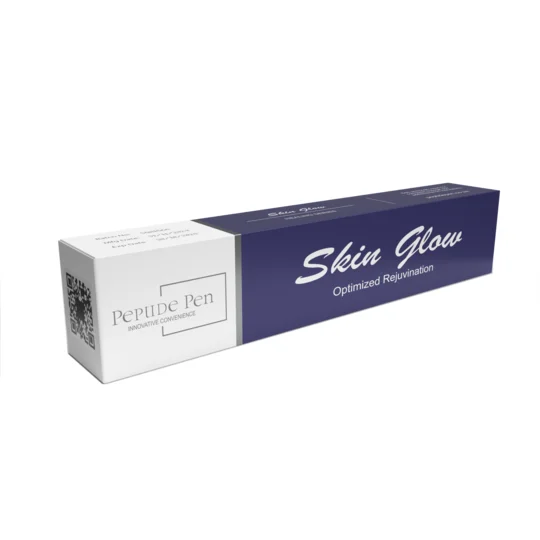
- Skin Glow 100mg pen from Peptide Pen: R800, about R8 per milligram. Pre-filled, 240 clicks at roughly 0.42mg each, with six sterile needles in the box.
- Glow Stack from Noventra Pharma: R1,600, a blend of skin and connective tissue peptides. Message us for the exact breakdown before you order.
For GHK-Cu the pen works out cheaper per milligram as well as easier, which is not true of every compound we sell. Peptide pens vs self-mix vials compares the whole range.
Commonly researched alongside
GHK-Cu turns up in the same protocols as BPC-157, TB-500 and KPV, because all of them are studied around tissue repair. BPC-157 vs TB-500 covers the first two, and the KPV Stack is the place to start on the third.
Prices are correct at the time of writing, September 2026. Everything we supply is for laboratory research use only and is not for human consumption.
Mixing a vial for the first time? How to reconstitute a peptide vial walks through it step by step, and the peptide calculator does the arithmetic.