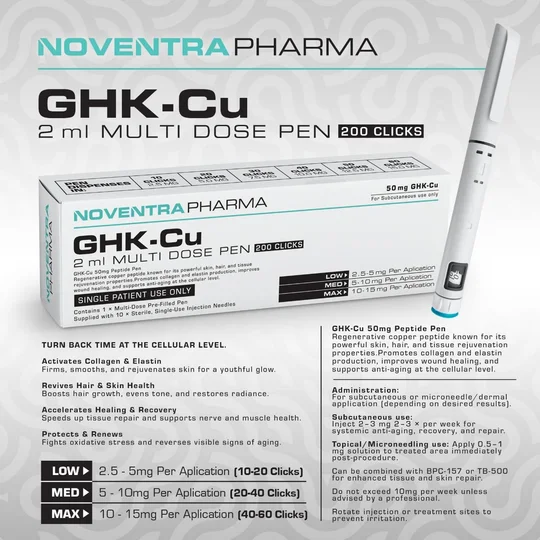
GHK-Cu 50mg
Product Overview
GHK-Cu is a copper tripeptide complex: the amino acid sequence glycyl-L-histidyl-L-lysine bound to a copper(II) ion. It occurs naturally in human plasma, where concentrations fall steadily from roughly age twenty onwards. That decline is why it turns up in so much skin and connective tissue research.
Product Specifications
- Active ingredient: GHK-Cu (copper tripeptide-1)
- Total amount: 50mg per vial
- Format: Lyophilised powder, sealed vial
- Reconstitution: Bacteriostatic water included in the box
- Appearance: Deep blue once reconstituted, which is the copper and is expected
- Regulatory status: Research use only. Not a registered medicine in South Africa and not evaluated by SAHPRA.
What GHK-Cu Is
The peptide itself is three amino acids long. What makes it interesting is the copper it carries and where it delivers it. Copper is a required cofactor for lysyl oxidase, the enzyme that cross-links collagen and elastin, and GHK appears to act as a carrier that moves copper into cells rather than leaving it loose in tissue.
It is one of the more heavily studied peptides on the market, which is unusual in this category. Most of that work is laboratory and topical, not injected human trials, and the distinction matters when you are reading claims elsewhere.
Research Applications
Collagen and Extracellular Matrix
Studied for effects on collagen I and III synthesis, elastin, glycosaminoglycans and proteoglycan production in fibroblast models.
Skin Research
Investigated in topical work looking at skin density, fine lines, firmness and photodamage.
Wound and Tissue Models
Examined in wound healing models for effects on angiogenesis, fibroblast recruitment and remodelling.
Hair Follicle Research
Copper peptides have been studied in relation to dermal papilla cells and follicle size.
Antioxidant and Inflammatory Signalling
Looked at in relation to superoxide dismutase activity and inflammatory mediators.
Mechanism of Action
Research points to several overlapping mechanisms rather than one:
- Copper delivery to lysyl oxidase and other copper dependent enzymes
- Stimulation of collagen and glycosaminoglycan synthesis in fibroblasts
- Modulation of matrix metalloproteinases and their inhibitors
- Angiogenic signalling including VEGF
- Antioxidant activity and iron chelation
- Broad gene expression changes reported in cultured human cells
Commonly Researched Alongside
- BPC-157
- TB-500
- KPV
Listed because these pairings come up constantly in published protocols and in what people actually order together, not because we are recommending a combination.
Reconstitution and Handling
Supplied lyophilised, with bacteriostatic water in the box. Reconstitution is done by the buyer, and the volume you choose determines the concentration you end up with. There is no single correct volume, only the one that makes your intended measurement easy to read on the syringe you are using.
- Let the vial reach room temperature before you open it.
- Wipe the stopper with an alcohol swab and let it dry.
- Run the bacteriostatic water slowly down the inside wall of the vial rather than straight onto the powder.
- Swirl gently until clear. Do not shake.
- Label the vial with the date and the concentration. You will not remember it in three weeks.
Our peptide calculator will work out the concentration and the volume per measurement for you once you have chosen a reconstitution volume. Our reconstitution guide walks through the whole process step by step.
Storage
- Ships lyophilised and is stable at room temperature in transit.
- Refrigerate on arrival and keep out of direct light.
- Do not freeze a reconstituted vial.
- Once reconstituted, keep refrigerated and treat it as a short shelf life rather than an indefinite one.
- Discard if the solution turns cloudy, changes colour or shows visible particles.
- Keep out of reach of children.
Storage, reconstitution and handling after delivery are the buyer’s responsibility.
What This Page Does Not Claim
Most of the strong GHK-Cu evidence is in vitro or topical. Extrapolating a fibroblast culture result to a whole person is a leap, and anyone telling you otherwise is selling harder than we are. Copper also has an upper limit as a nutrient, so quantity is not a free variable.
Our guide GHK-Cu: what the copper peptide does, and what it does not covers the research in more depth and compares the vial and pen on price.
Regulatory Status and Notice
GHK-Cu is not a registered medicine in South Africa and has not been evaluated by SAHPRA. It is supplied as a lyophilised vial for laboratory research use only, and is not for human or veterinary consumption.
Nothing on this page is medical advice, and none of the research described below establishes a clinical outcome in people. Where the evidence is thin, we say so on the page rather than leaving you to find out afterwards.